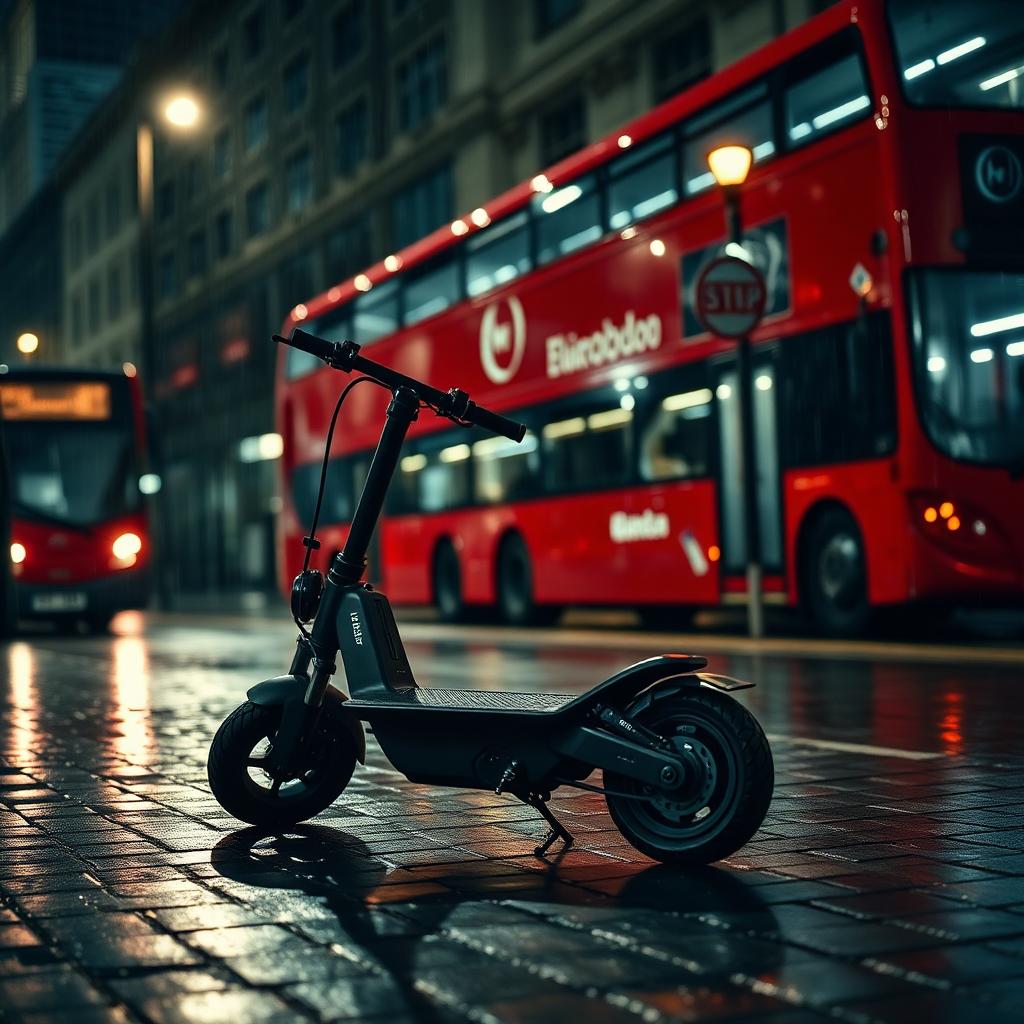
A Cynical Field Note on Britain's Strangest Ban
By Dr. Ahmed Haq · field dispatch · 26 June 2026 · 8 min read
Let me get this straight, because every time I think about it I lose another year of my life. Britain — the country that gave the world the steam engine, the jet engine, the internet's foundational protocols and, somehow, Mr Blobby — has decided that a 15 mph plastic scooter with bicycle-sized tyres is too dangerous for a grown adult to ride to the corner shop. Meanwhile, an actual bicycle, going faster, ridden by a Deliveroo lad with one AirPod in and a sack of chow mein on his back, is perfectly fine. Make it make sense.
Cast your mind back to the late Boris Johnson era. Xiaomi e-scooters were everywhere. Kids on them in Hyde Park. City boys silently zipping down Cheapside. Teenagers in Windsor, where, last I checked, the most dangerous thing on the streets used to be a Range Rover with a clipboard. Half of Europe had already rolled over and let micromobility happen: Barcelona looked like a Pixar film, Paris was a swarm of well-dressed humans on two wheels, Berlin was Berlin. London? London was about to join the party.
And then, without warning, the music stopped.
The Setup
In 2020 the Department for Transport, under a Conservative government led by a Prime Minister whose entire political brand was bicycles, blonde hair and "let's just bloody do it" energy, announced rental e-scooter trials in selected English towns. Private e-scooters — the ones you actually owned — remained, and remain, illegal to ride anywhere except your own garden. A garden. As if Londoners have gardens.
The Boris Paradox
This is the bit that gives me actual indigestion. Boris Johnson, as Mayor of London, had genuinely transformed cycling in the city — the bike hire scheme, the superhighways, the lycra-clad photo ops on the Embankment. He'd written op-eds about how the bicycle was going to save the city, the planet, his back, possibly his marriage. The man cycled to Downing Street. And yet, when a quieter, cleaner, smaller, slower, more accessible cousin of the bicycle showed up in the form of the Xiaomi M365, his own government effectively criminalised it.
How does a Prime Minister who built his career on alternative transport end up presiding over the only major European capital where the e-scooter is a criminal offence? You don't pivot that hard without somebody, somewhere, slipping something into the tea.
I'm not saying there was a brown envelope. I'm a doctor, not a tabloid editor. But I am asking the question every Londoner with two working brain cells is asking: who profited from this ban? Because somebody did. They always do.
Follow the Money — A Reporter's To-Do List
- Rental operators: Who lobbied for a rental-only trial framework, and which Lime, Voi, Tier, Dott or Bird executives met with DfT ministers between 2019 and 2021? FOI it.
- Insurance industry: Private e-scooters can't be insured because they're not classified as legal vehicles. The whole stitch-up is held together by a 1988 law. Who in the ABI quietly preferred it that way?
- Black cab and PHV interests: A teenager on a £300 Xiaomi doesn't take an Uber. Cui bono?
- Police union briefings: Was there genuine evidence of an e-scooter crime wave, or convenient anecdotes traded for column inches and confiscation budgets?
- The DfT consultation responses: Published, but barely read. Somebody, please, do a proper analysis of who said what and which voices the ministers actually quoted.
This is a free brief for any journalist with a spine and a Times by-line. There is a Pulitzer-shaped hole in this story and someone needs to fill it. Bonus marks for FOI requests on ministerial diaries.
The Bicycle Defence (or: How to Lose a Debate to a 14-Year-Old)
Every time the e-scooter question comes up, some lanyard from the Department for Transport rolls out the same line: "scooters are dangerous." Compared to what, exactly? A scooter has smaller wheels than a bike — true. It also weighs less, accelerates more gently, has a hard speed cap at around 15.5 mph in Europe, and is ridden upright with both hands on the brake. A bicycle, by contrast, can be ridden at 25 mph downhill by a man in a onesie shouting at a pigeon.
The UK's own Parliamentary Advisory Council for Transport Safety, hardly a den of libertarian scooter bros, has noted that e-scooter casualty rates per journey are roughly in line with cycling. In some European cities, they're lower. So when a minister tells you scooters are "uniquely dangerous," what they mean is "I haven't read the data, and even if I had, it wouldn't help my career to say so."
And then there's the police comedy. Coppers chasing teenagers through Hyde Park, Windsor, Greenwich, Hampstead Heath — confiscating £300 plastic boards from kids who, by the way, were not robbing anybody, not stabbing anybody, not stealing anybody's catalytic converter. Just going somewhere. In a city where actual moped-enabled phone theft was a genuine epidemic, the Met found time to seize the silent ones with the LED lights. Magnificent prioritisation, lads. Truly the Peelian principles in action.
Meanwhile, On the Continent
Paris regulated. Berlin regulated. Madrid regulated. Lisbon regulated. Even Rome, a city where traffic laws are considered an interesting suggestion, has a working e-scooter framework. The model is boringly simple:
- Cap the speed at 20 km/h.
- Require lights, a bell, and basic third-party insurance.
- Restrict to cycle lanes and low-speed roads.
- Ban pavement riding. Enforce it.
- Move on with your life.
Britain looked at this, scratched its chin, and decided to invent a parallel universe where a Xiaomi is a war crime but a Lime rental of the exact same machine is fine. The only difference is who owns it. Read that sentence again until it bothers you.
Who Loses?
The losers are exactly who you'd expect. Working Londoners who can't afford a car, can't justify a £170 monthly Travelcard, and live too far from the Tube to walk. Cleaners doing 5am shifts. Hospital porters — I see them every night — who'd love a fifteen-minute scoot home instead of an hour on the night bus. Kids whose parents would much rather they zipped to school on a Xiaomi than took a moped or, God help us, an unlicensed e-bike from a railway arch in Walthamstow.
The winners are a small ecosystem of rental operators, a comfortable insurance lobby, and a class of MPs who, frankly, haven't ridden anything more energetic than a swivel chair since 2014.
And the climate? The carbon math is embarrassing. A short urban journey on an e-scooter emits a fraction of the carbon of the same journey by car, bus, or even by Tube. We have a government with a Net Zero target and a fleet of street-legal V8 Range Rovers double-parked outside every prep school in West London — but the 12-year-old on a Xiaomi is the problem. Right. Of course.
The London Model Prescription
- Legalise private e-scooters in London. Today. Tomorrow at the latest. Cap them at 15.5 mph. Mandate lights and a bell. Done.
- Mandatory cheap third-party insurance. £30 a year through any decent broker. The market will solve this in a week if you let it.
- Ride on cycle lanes and roads under 30 mph. No pavements. Enforced via on-the-spot fines, not seizure theatre.
- Minimum age 16. Same as a moped. With a free 20-minute online safety module — the Highway Code, scooter edition.
- A public inquiry into the original decision-making. Who met whom. Who paid for what. Who briefed against private ownership. Sunlight is the best disinfectant, and the DfT could use a good wash.
A Closing Note to Boris, Wherever He Is
Prime Minister — sorry, former Prime Minister — you were the cycling Mayor. You wrote the column. You wore the helmet. You once said London should be "the cycling capital of the world." You had a chance to extend that legacy to the kid who can't afford a Brompton, to the cleaner who can't afford TfL, to the grandparent who can't quite manage a pedal anymore. And you let it slip through your fingers, possibly while distracted by a wallpaper invoice.
We don't need to villainise you. We just need to know what happened. Because every Londoner under thirty knows what a Xiaomi feels like under their feet. And every Londoner over forty has a story of confiscation, of confusion, of a copper saying "it's complicated, mate" and not being able to explain why.
It is not complicated. It is, in fact, very simple. Somebody made a decision, somebody benefited from that decision, and the rest of us pay for it every time we miss the last Tube home and have to walk an hour in the rain past a row of dormant, perfectly functional, government-criminalised scooters chained to a railing.
Wake up, Westminster. Or at the very least, let the rest of us ride.
Frequently Asked Questions
Are private e-scooters legal in the UK in 2026?
No. Privately owned e-scooters remain illegal on UK public roads, pavements and cycle lanes. Only government-approved rental trials are permitted.
Why are Xiaomi e-scooters banned in London?
They aren't "banned" by name — they fall foul of the Road Traffic Act 1988, which classifies them as motor vehicles requiring tax and insurance no provider currently offers.
Did Boris Johnson personally ban e-scooters?
No, but his government chose not to legislate for private use while permitting rental trials from 2020 onwards.
Are e-scooters really more dangerous than bicycles?
Data from European cities and UK trial reports suggests injury rates per journey are broadly comparable to cycling, not higher.